Let’s get straight to it. Strategy is simply the way a company differentiates itself (through its operations) from competing firms within an industry. The firm must be able to maintain this difference for the strategy to be a valid one. According to Michael E. Porter, strategy emerges from 3 often overlapping sources namely: variety-based positioning, needs-based positioning and access-based positioning.
variety-based positioning
This involves producing a subset of an industry’s products or services using distinctive sets of activities. In oil and gas, Oxy’s strategic focus on carbon capture and low-carbon oil production exemplifies this approach - they’re not trying to be everything to everyone, just the best at producing oil with a demonstrably lower carbon footprint. While other companies chase multiple energy sources, Oxy plans to meet almost 30% of its new Permian Basin compression needs with electric compressors and targets net-zero greenhouse gas emissions by 2030. This variety-based positioning serves customers who increasingly value lower-carbon production, creating a sustainable competitive advantage through focused differentiation.
needs-based positioning
This emerges when there are groups of customers with differing needs, and when a tailored set of activities can serve those needs best. National oil companies (NOCs) in the Middle East demonstrate this perfectly - they’re serving fundamentally different customer needs than US shale producers. While US companies focus on extraction efficiency and capital discipline, NOCs like ADNOC are investing in boosting hydrocarbon production capacity while developing integrated midstream and downstream infrastructure, partnering with technology firms to boost digital capabilities and adopting more customer-centric strategies. Same industry, but totally different customer needs requiring entirely different operational configurations.
access-based positioning
This involves segmenting customers who are accessible in different ways, requiring different configurations of activities to reach them effectively. Think of how some companies focus exclusively on certain basins or geographies where their operational model creates unique advantages. Companies targeting remote offshore operations require vastly different capabilities than those focusing on onshore shale plays, leading to distinct strategic positions based on geographic and technological access requirements.
Now in order to maintain their chosen strategic position, oil and gas firms need to make some trade-offs which might arise from any combination of the following reasons:
- inconsistencies in image or reputation
- the need to tailor current operations to the strategy by cutting certain services or avtivities off
- limits on internal coordination
Recent mega-mergers like ExxonMobil’s $60 billion Pioneer acquisition and Chevron’s $53 billion Hess deal illustrate companies avoiding trade-offs - attempting to dominate multiple basins rather than choosing a focused strategic position. This often leads to what Porter calls ‘straddling,’ which is trying to serve multiple positions at once, ultimately weakening competitive advantage.
Choices of strategic positioning determine not only which activities a company will perform and how it will configure individual activities but also how activities relate to one another. While operational effectiveness is about achieving excellence in individual activities, or functions, strategy is about combining activities in ways that fit. This fit is what locks out imitations that leads to zero strategic position improvement for firms that pioneer operationally effective activities.
The AI Acceleration Pattern
This pattern of operational effectiveness masquerading as strategy is accelerating dramatically with AI adoption. Despite over 90% of organizations increasing their generative AI use, only 8% consider their initiatives mature - suggesting most are treating AI as operational effectiveness rather than strategic differentiation. When oil and gas companies implement AI for ‘predictive maintenance,’ ‘supply chain optimization,’ or ‘exploration analytics,’ they’re often just doing what everyone else is doing, faster.
Finally, I like to learn via negativa so I will be looking at what strategy is NOT in order to arrive at a more refined sculpture of what strategy is/should be especially in this age of AI.
We have to understand that best practices are not strategy. why? Because they are easily emulated by competing firms in the industry. This leads to competitive convergence within the industry through benchmarking, where all oil and gas firms end up ‘same-same’ with no unique strategy about them. This is not a bad thing for the industry as a whole because it persistently shifts the productivity frontiers to the right at a very fast pace.
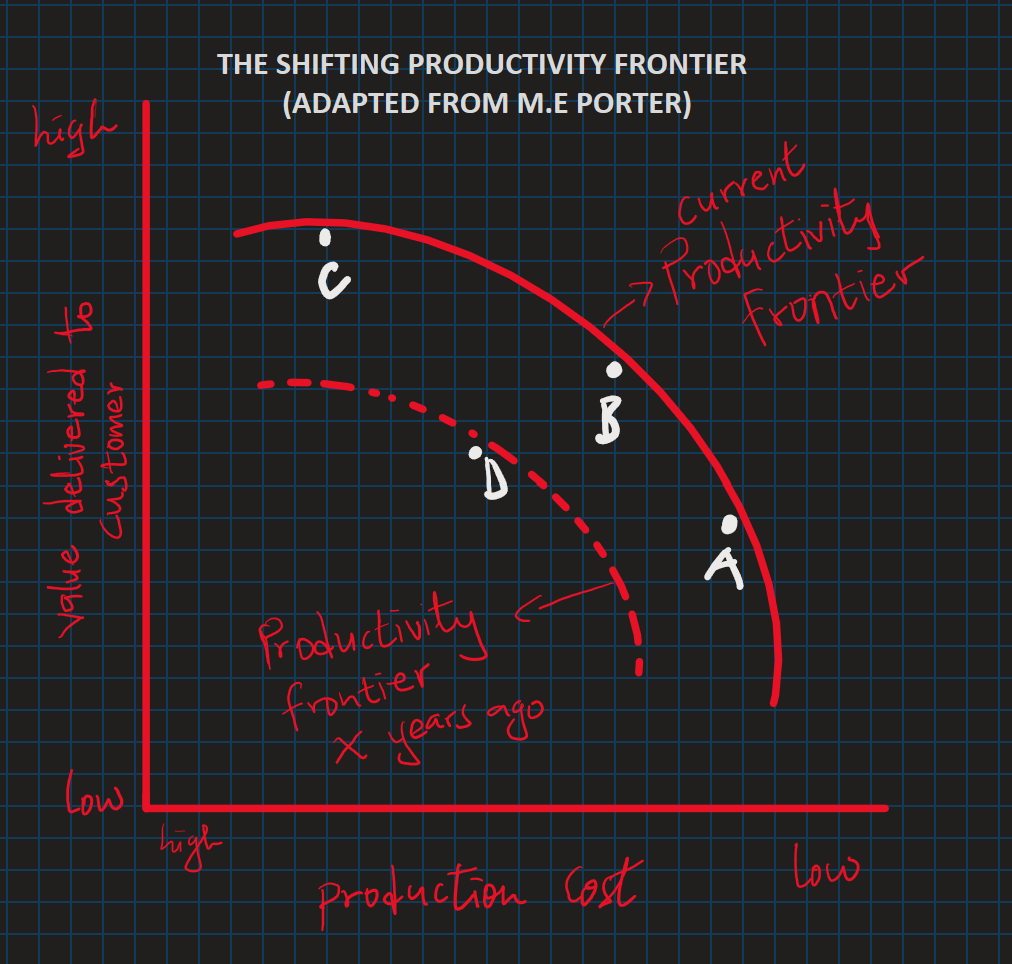 figure 1- Change in productivity frontiers due to emerging best practices. Adapted from this HBR article by Michael Porter
The problem, however, is that for individual oil and gas firms that may have pioneered particular methods for effective operations, they get frustrated when they repeatedly discover that their pioneering methods/activities were not tickets to their sustained profitability against competitors. Their “strategic positioning” –notice the air quotes– only end up increasing operational effectiveness for all firms within the industry, without improvement to their relative strategic positions within the industry.The current AI hype exemplifies this confusion. When companies say they’re ‘using AI for competitive advantage,’ they’re often just adopting the same tools as everyone else. True strategic AI use would involve trade-offs that is choosing NOT to serve certain customers or markets to better serve others with AI-enhanced capabilities.
Final words
Improving operational effectiveness is a necessary part of management, but it is definitely not strategy. And it’s not managers’ fault for thinking that it is, effectively driving the oil and gas industry into competitive convergence. Managers must clearly distinguish operational effectiveness from strategy. Both are important, but have their own differences. Operational effectiveness involves continual improvement in all operational departments (can even call it Kaizen) with no trade-offs. This is important because even the oil and gas firms with the best strategic positionings will miss out on the new productivity frontier (no one wants to be firm D in figure1). So yes, this involves relentless efforts to be in the best spot on the ever-shifting productivity frontier. That sounds exhausting for managers but it’s not as exhausting when real and disciplined strategy is the fulcrum on which they are leading their firms in this stiffly competitive oil and gas industry.
References
Porter, M.E. and Strategy, C., 1980. Techniques for analyzing industries and competitors. Competitive Strategy. New York: Free, 1.